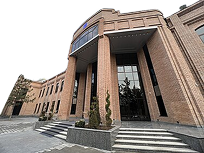
We are proud to say that, in the Centre for Academic Excellence our local and international faculty staff form a symbiosis of experiences and scientific quality that offers the best service to our students.
Students have a set of core courses on the English Language, Critical Thinking Skills, Mathematics, Digital Information, and Humanities along with other courses that will provide heavy and stable pillars of knowledge, for each of their areas of expertise. Courses on Economics, Management, Programming, and Physics will be needed, depending on each individual student's Degree plan.
It is our strong belief that with hard work and devoted commitment from students with a strong Foundation background, success in studies and a future professional environment is at a near distance.
Thus, we are proud to receive all the new students with a promise of full dedication and attention to them, from our very diverse and highly qualified faculty members.

Learning takes place through a combination of face-to-face teaching and independent study, including lectures, practical tutorials, laboratory sessions, personal development sessions, real-life project briefs and case studies.
Students study 60 ECTS credits per year. The structure of the course is a subject to change by feedback received from a variety of sources.
| First Year | ||||
|---|---|---|---|---|
| Semester | Course Code | Course | Course Type | ECTS Credits |
| Semester 1 | ED311 | Education, Society, Culture and STEM | Core | 6 |
| HASS101 | Academic and Communication Skills 1 | Core | 6 | |
| CS100 | Information Systems and Digital Technologies | Core | 6 | |
| MATH101 | Precalculus | Core | 6 | |
| HASS100 | First Principles of NewUU | Core | 6 | |
| Semester 2 | ED111 | Introduction to STEM Education and Teaching | Core | 6 |
| HASS111 | Academic and Communication Skills 2 | Core | 6 | |
| CS102 | Computer Programming 1 | Core | 8 | |
| MATH111 | Calculus 1 | Core | 6 | |
| MATH130 | Statistical Methods | Core | 6 | |
| Total Credits | 62 | |||
| Second Year | ||||
| Semester | Course Code | Course | Course Type | ECTS Credits |
| Semester 3 | CS30 | Introduction to Data Science | Core | 4 |
| ED410 | Game-based Learning and Gamification for the Classroom | Elective | 4 | |
| CS210 | Computer Programming 2 | Core | 8 | |
| MATH211 | Calculus 2 | Core | 6 | |
| Class Management | Core | 6 | ||
| ED302 | Introduction to Teaching Math | Core | 6 | |
| Semester 4 | ED321 | Foundations of AI Literacy | Elective | 4 |
| ED211 | Assessment & Evaluation in Education | Core | 6 | |
| CS301 | Fundamentals of Databases | Core | 6 | |
| MATH221 | Discrete Mathematics | Core | 6 | |
| HASS110 | History of Uzbekistan | Core | 4 | |
| ED291 | Pedagogical Internship 1 | Core | 6 | |
| Total Credits | 66 | |||
| Third Year | ||||
| Semester | Course Code | Course | Course Type | ECTS Credits |
| Semester 5 | ED310 | Introduction to Teaching Technology | Core | 6 |
| ED241 | The Art of STEAM Communcation | Elective | 4 | |
| MATH321 | Introduction to Number Theory and Cryptography | Core | 6 | |
| CS331 | Introduction to Machine Learning | Core | 6 | |
| SEC111 | Computer Security | Core | 6 | |
| Semester 6 | ED320 | Interdisciplinary literacies in STEM | Core | 6 |
| ED231 | Educational Psychology | Core | 6 | |
| HASS305 | Philosophy | Core | 6 | |
| ED331 | Research Methodology | Core | 6 | |
| MATH380 | Foundations and Applications of Geometry | Elective | 6 | |
| ED391 | Pedagogical Internship 2 | Core | 6 | |
| Total Credits | 64 | |||
| Fourth Year | ||||
| Semester | Course Code | Course | Course Type | ECTS Credits |
| Semester 7 | ED421 | Teaching, Technology and AI Pedagogies | Elective | 4 |
| ED221 | Curriculum Development & Instruction | Core | 6 | |
| ED402 | Real-World Learning, Project, Case and Problem-based Learning | Elective | 4 | |
| ED460 | Foundations of Research Proposal Writing | Core | 6 | |
| ED315 | Coding for Educators | Elective | 4 | |
| ED450 | Digital Media and Technology in STEM Education | Elective | 4 | |
| Semester 8 | ED491 | Pedagogical Internship 3 | Core | 10 |
| ED441 | Graduation Project | Core | 8 | |
| ED431 | Professional Development and Leadership in STEM Education | Core | 6 | |
| ED411 | Professional Ethics and Legal Issues in Education | Core | 6 | |
| Total Credits | 58 | |||
| Program's Total Credits | 250 | |||
| Course Code | Course | ECTS Credits | Description |
|---|---|---|---|
| PHYS101 | Physics 1 | 8 | Physics 1 offers an introductory exploration of classical physics principles. Covering mechanics, basic thermodynamics and waves, this course builds a foundational understanding of the physical laws that govern our world. Through lectures, discussions, and hands-on labs, students develop analytical and problem-solving skills. Starting with kinematics, dynamics, and energy conservation, topics progress to universal gravitation, planetary motion, and thermodynamics. Wave behavior is studied, including mechanical vibrations, sound waves, and practical wave phenomena. Labs enable students to apply theory to real-world experiments, honing practical abilities. Physics 1 also highlights physics' everyday relevance and technological applications. By course end, students grasp classical physics' essentials, priming them for advanced studies and fostering critical thinking about the natural world. |
| HASS101 | Academic and Communication Skills 1 | 6 | This course is designed to help students improve their English language skills at an intermediate level. It focuses on developing speaking, listening, reading, and writing skills using materials from National Geographic Learning and Cengage Learning. |
| CS100 | Information Systems and Digital Technologies | 6 | Information Systems & Digital Technologies is a dynamic course designed to provide students with a comprehensive understanding of the intersection between information systems and digital technologies in today's rapidly evolving business environment. This course explores how organizations utilize digital technologies to manage information effectively, enhance decision-making processes, and drive innovation.Throughout the course, students will engage in lectures, discussions, hands-on activities, and projects to deepen their understanding of information systems and digital technologies concepts and practices. By the end of the course, students will be equipped with the knowledge and skills needed to leverage digital technologies effectively to address business challenges and opportunities in a globalized digital economy. |
| MATH111 | Calculus 1 | 6 | This is the first course from a sequence of 3 calculus courses. It deals with limits, continuity, differentiation and integration, applications of the derivative to determine the shape of graphs, evaluation of limits by the L’Hôpital Rule, finding the maximum and the minimum values of functions along with the problems of finding rates. The course ends with the introduction of indefinite and definite integrals, integration by parts, u-substitution, trigonometric substitution, integration of rational functions, improper integrals and applications to area problems. |
| HASS100 | First Principles of NewUU | 6 | This course equips first-year students with the knowledge, skills, and attitudes necessary for success in higher education at New Uzbekistan University (NEWUU). It introduces students to the role and purpose of higher education, university governance, and academic policies, while fostering information literacy, academic integrity, and ethical reasoning. Through weekly themes, students will practice time management, effective study strategies, reading and note-taking, as well as develop critical, analytical, and creative thinking skills. The course also emphasizes digital literacy and responsible engagement with emerging technologies such as AI, alongside communication, teamwork, and intercultural competence. By exploring NEWUU's academic programs and career pathways, students will be encouraged to connect their studies with long-term personal and professional goals. Ultimately, the course integrates foundational knowledge of institutional expectations with transferable skills in problem-solving, innovation, and communication, preparing students for responsible, resilient, and successful participation in academic and societal life. |
| CHEM101 | General Chemistry | 8 | This course provides an introduction to the chemistry of inorganic molecules. The emphasis is on basic principles of atomic and molecular electronic structure, thermodynamics and acid-base equilibria. The relationships between chemistry and other fundamental sciences (such as biology and physics) and the applications of chemistry to environmental science, atmospheric chemistry and electronic devices are highlighted. The lectures will be accompanied by a laboratory course to allow students to complement the study of theoretical concepts with the practical experience acquired by conducting experiments. |
| HASS111 | Academic and Communication Skills 2 | 6 | This course is designed to help students improve their English language skills at an intermediate level. It focuses on developing speaking, listening, reading, and writing skills using materials from National Geographic Learning and Cengage Learning. |
| DSG101 | Creative Thinking and Design | 6 | This course is designed to cultivate creative thinking abilities and enhance study strategies, presentation skills, enabling students to communicate their ideas effectively and innovatively. In today's dynamic world, creative problem-solving and persuasive communication are essential skills for personal and professional success. This course combines theory and practical exercises to develop both the creative mindset and the ability to articulate ideas persuasively. |
| MATH211 | Calculus 2 | 6 | This is the second course from a sequence of 3 calculus courses. It deals with numerical series and sequences, parametric equations and polar coordinates, scalars functions of several variable and double integrals. Special focus on tests convergence/divergence of series and optimization. |
| PHYS111 | Physics 2 | 8 | Physics 2 is the second course in a two-course sequence that provides a comprehensive introduction to the principles of physics. This course builds upon the concepts introduced in Physics 1 and covers a wide range of topics in electricity and magnetism, optics, and modern physics. The course begins with an introduction to electrostatics, including Coulomb's Law, electric fields, and electric potential. Students will learn about capacitance, electric circuits, and the properties of conductors and insulators. The course will then cover magnetism, including magnetic fields, magnetic forces, and magnetic induction. In the second part of the course, students will learn about wave optics, including interference, diffraction, and polarization. The course will then introduce modern physics, covering topics such as special relativity, quantum mechanics, and nuclear physics. |
| CHEM201 | Analytical Chemistry | 6 | This course is a foundational course that focuses on the principles, methods, and applications of chemical analysis. The course provides students with the knowledge and skills necessary to perform qualitative and quantitative analysis of chemical substances and understand the underlying principles governing analytical techniques. Emphasis is placed on developing critical thinking, problem-solving abilities, and laboratory proficiency in various analytical methods. |
| MATH201 | Linear Algebra | 6 | This course provides an introduction to fundamental concepts in linear algebra, including solving linear systems using Gauss-Jordan elimination and other methods, matrix operations, and linear transformations. Students will explore inverse matrices, image and kernel, basis and dimension, and coordinate representations in vector spaces. The course covers orthonormal bases, the Gram-Schmidt process, QR factorization, determinants, eigenvalues, eigenvectors, and matrix diagonalization. Applications to dynamical systems, including complex eigenvalues, will also be discussed. Through theoretical study and practical exercises, students will develop problem-solving skills essential for various fields. |
| CHEM211 | Fundamentals of Physical Chemistry | 6 | This course provides a comprehensive introduction to the principles and concepts underlying the behavior of matter at the molecular and atomic levels. It is designed to equip students with the foundational knowledge required to understand the physical and chemical properties of substances, as well as the fundamental processes governing chemical reactions and interactions. Throughout the course, students will explore various topics including thermodynamics, chemical kinetics, quantum mechanics, and spectroscopy, among others. Emphasis is placed on developing a strong conceptual understanding of these topics and their applications in explaining and predicting the behavior of chemical systems. |
| MENG201 | Engineering Mechanics 1 | 6 | Topics to be covered include equivalent systems of forces, resultants and distributed forces, equilibrium of rigid bodies, centroids, centers of gravity, fluid statics, moments of inertia, friction and virtual work. Analysis of frames and machines, forces in beams, internal stresses, and stability will also be considered. Vector algebra will be used throughout. |
| CENG201 | Chemical Engineering Principles | 6 | This course will provide an introduction to the principles and calculation techniques used in the field of Chemical Engineering. It gives an overview of chemical engineering through the analysis of physical and chemical processes covering topics such as material and energy balances, concepts of rate processes, behaviour of gases liquids and solids, and kinetics of chemical reactions. Applications of these concepts to areas of current technological importance: energy, production of chemicals, materials processing is also discussed. This course is designed to: Understand the overall view of the chemical engineering subjects provide students with the fundamentals of material and energy balances as applied to chemical engineering to enable the analysis of a chemical process. Develop efficient methods of and life-long skills for problem solving through exercise problems Give an overview of mathematical techniques, modelling and simulations in chemical engineering Introduce students to the various areas and facets of current Chemical Engineering research. |
| MGT101 | Principles of Management | 6 | This course is a foundational course specifically designed for undergraduate freshmen. It delves into the core principles of management, distinguishing itself from broader business studies by focusing exclusively on managerial theories, practices, and applications. The curriculum is structured to provide a rigorous examination of the fundamental concepts underpinning effective management. It emphasizes the role of management in planning, organizing, leading, and controlling within organizational contexts. Additionally, the course offers an analytical overview of decision-making processes, organizational structures, and the dynamics of leadership. Key areas of study within the course include the evolution of management theories, the design and structure of organizations, strategic planning, human resource management, and contemporary challenges in managerial roles. Upon completion of the course, students will have acquired a comprehensive understanding of the principles that guide effective management in various organizational settings. MGT 101 is designed to equip students with a foundational understanding of management, ensuring their preparedness for advanced studies in the field. |
| PHYS231 | Solid State Physics | 6 | The course introduces the fundamental principles governing the physical properties of solids. Topics include crystal structures, lattice vibrations, electronic band theory, semiconductors, and magnetism. The course emphasizes the theoretical foundations and experimental techniques used to understand the electrical, thermal, and optical properties of materials. |
| CHEM231 | Organic Chemistry | 6 | This course is an introduction to advanced organic chemistry. An emphasis will be placed on stereochemistry, structure-reactivity relationships, reactive intermediates, organic reaction mechanisms, and spectroscopic methods. An important goal of the lecture is also to present new material that helps to supplement the material in the textbook. The lectures will be accompanied by a laboratory course to allow students to complement the study of theoretical concepts with the practical experience acquired by conducting experiments. |
| MATH241 | Ordinary Differential Equations | 6 | This course provides an introduction to ordinary differential equations, covering methods for solving first-order and higher-order equations, including linear, separable, and exact equations. Students will explore solutions to differential equations with constant and variable coefficients, power series methods, and Laplace transforms. The course also introduces systems of linear differential equations, employing matrix methods and phase portraits for analysis. Additionally, students will study nonlinear systems, focusing on stability, linearization, and applications. Emphasis is placed on both analytical and numerical techniques, with applications across various scientific and engineering fields. |
| HASS110 | History of Uzbekistan | 4 | This course introduces foundation year students to the basic concepts and principles of history, in particular contemporary of Uzbekistan. The course is to provide students with an opportunity to acquire basic knowledge of historical understanding, history as a subject, its logics, foundation of statehood, state formation, latest reforms and policy in Uzbekistan. |
| PHYS221 | Engineering Thermodynamics | 6 | This course provides an introduction to the fundamental principles of thermodynamics, focusing on the concepts of energy, heat, and work. Students will explore the laws of thermodynamics and their applications in physical and chemical systems. Key topics include the properties of gases, the Carnot cycle, entropy, and thermodynamic potentials. Through a combination of lectures and practical exercises, students will develop a foundational understanding of how thermodynamics governs the behavior of systems in equilibrium and impacts various scientific and engineering fields. |
| MSE301 | Nanotechnology and Advanced Materials Engineering | 6 | In today’s society, the development of all advanced science and technology fields such as automobiles, aerospace, shipbuilding, heavy chemical industry, energy industry, semiconductors, and electric/electronic industry is impossible without the development of new and/or advanced materials. nanotechnology and advanced materials technology, which are recognized as one of the 21st century’s key technologies, deal with all materials from conventional bulk materials to nano-scale materials (nm, 10-9 meters). Based on basic sciences such as physics, chemistry, and mathematics, this course covers a wide range of topics including the design of materials, the analysis of materials’ extrinsic/intrinsic properties, and the study of manufacturing processes for metals, ceramics, semiconductors, and polymers which are used in various fields such as machinery, steel, aviation, space, electronics, energy, environmental, and medicine. Through this course, students will be able to get specialized knowledge for creative applications and learn more systematically in experimental design courses. As such, we are endeavoring to nourish experts who have adaptability to real-world situations and problem-solving skills. |
| MENG241 | Fluid Mechanics | 6 | The module Fluid Mechanics mediates the basics of mechanics of gases and fluids and belongs therefore to the field of classical mechanics as part of engineering education. Based on the content of the module Fluid Mechanics further lectures in the following semesters with the following contents could be attended: (1) Physics of fluids, (2) Kinematics of fluids, (3) Conservation laws for mass and momentum, (4) The Bernoulli-equation, (5) Conservation law for energy, (6) Navier-Stokes-equations, (7) Turbulence, (8) Technical Flows. |
| MATH301 | Numerical Methods for Engineers | 6 | This course equips engineering students with essential numerical methods for solving mathematical problems in engineering. It covers foundational concepts like round-off errors, algorithms, and numerical software, progressing to techniques for solving equations, numerical differentiation and integration, and matrix algebra. Students will also explore approximation theory, eigenvalue approximations, nonlinear systems, and the finite-element method for partial differential equations. Basic calculus is recommended, with supplementary materials available for those new to differential equations. |
| EENG201 | Electrical and Electronic Circuits | 6 | All electrical devices and computers are based upon some electric elements and circuits. The purpose of this course is to provide the students with a basic knowledge of linear circuits, and linear circuit elements (like voltage and current sources, resistors, capacitors, and inductors). The goal is to develop an understanding of the analysis of electric circuits and an analytic approach to solving a circuit network using different techniques and theorems. Semiconductors are of obvious importance, as they are the basis for the development of modern electronics. Semiconductors, the lifeblood of microchips that epitomize modern technology, are special in many ways. Semiconductors are materials that conduct electricity better than insulators, but not as well as conductors. Yet, by altering their structure a little bit, we gain the ability to build components whose electrical properties we can control with tremendous ease, allowing us to use them in electronic applications in so many ways. The second half of this course will then start to talk about the basics of semiconductor devices (Diodes and Transistors), their types, and functions. This detailed course description aims to prepare students for a wide range of career opportunities in engineering, ensuring they have a strong foundation in theory while emphasizing ethical, safety, and sustainability considerations in their work. |
| CENG311 | Separation processes | 6 | This course describes in depth separation methods including distillation, absorption, and extraction as well as computer-based solutions to separation problems. Also, it studies mass transfer rate processes, including diffusion, microscopic material balances. It Applies mass transfer rate theory to packed and tray columns. The course also covers drying techniques, membrane and ion exchange separation techniques. It aims at understanding the principles for designing selected separation units including distillation columns, gas absorption columns, extraction processes, washing and leaching processes, membrane processes and absorption columns. |
| MENG361 | Heat Transfer Phenomena | 6 | Heat transfer is the study of thermal energy transfer between materials due to a temperature difference. It involves heat propagation through solids and fluids, or can take place through a vacuum. The objective of this course is to provide a first exposure for students to the study of heat transfer. The underlying physical mechanism of heat transfer and techniques for analysing heat transfer in engineering systems will be presented. |
| CENG351 | Chemical Engineering Lab 1 | 6 | The course is to provide practical and theoretical experience in a number of important chemical engineering unit operations ensuring a thorough understanding of the principles of unit operation and material selection. The course includes design and development, data analysis and error analysis, skills development in oral presentation, technical report writing, and team-building. The experiments are designed to illustrate the principles of fluid , heat transfer, and chemical reactor engineering. Safe operating procedures and risk assessments for some unit operations will be developed. Lectures in the course will cover basic machine learning and data analytics for chemical engineering, experimental error analysis, process safety and the provision of utilities in chemical plants. |
| CENG331 | Biochemistry | 6 | This course provides an in-depth exploration of the fundamental principles and concepts underlying the chemical processes within living organisms. Topics covered include the structure and function of biomolecules such as proteins, carbohydrates, lipids, and nucleic acids, as well as their roles in metabolism, energy production, and cellular signaling. Emphasis is placed on understanding enzyme kinetics, metabolic pathways, and the regulation of biochemical reactions. Additionally, the course covers contemporary applications of biochemistry in areas such as medicine, biotechnology, and pharmacology. Laboratory sessions provide hands-on experience in experimental techniques used in biochemistry research. |
| HASS305 | Philosophy | 6 | This course will introduce you to the Western philosophical tradition through the study of thinkers such as Plato, Aristotle, Descartes, Hume, Kant, and others. Students will grapple with questions that have been significant to philosophy from its beginnings: Questions about the nature of the mind, the foundations of knowledge, and the good life. They will also observe changes in intellectual outlook over time, and the effect of scientific, religious, and political concerns on the development of philosophical ideas. |
| CENG301 | Chemical Reaction Engineering | 6 | This course provides a comprehensive introduction to the principles and applications of chemical reaction engineering. Students will explore the fundamentals of chemical kinetics, reactor design, and the interplay of physical and chemical processes in reactors. The course emphasizes the development and application of mathematical models to analyze and design chemical reactors, considering factors such as reaction rates, mass and energy balances, and transport phenomena. Key topics include ideal reactor models (batch, continuous-stirred tank, and plug flow reactors), non-ideal reactor behavior, catalysis, and the effects of temperature and pressure on reaction rates. Through lectures, problem-solving sessions, and laboratory experiments, students will gain the skills necessary to design efficient and sustainable chemical processes for various industrial applications. |
| CENG341 | Chemical Engineering Design 1 | 6 | The course is about the application of chemical engineering principles and methods of chemical process synthesis, simulation and economics on open ended process and/or product design problems. Students will use of computer programming and/or design packages in iterative decision making and optimization. Emphasis on process safety and ethical issues. Process flow-sheeting, design constraints and standard will be introduced |
| CENG451 | Chemical Engineering Lab 2 | 6 | This course is to provide practical and theoretical experience in a number of important chemical engineering unit operations ensuring a thorough understanding of the principles of unit operation and material selection. The course includes design and development, data analysis and error analysis, skills development in oral presentation, technical report writing, and team-building. The experiments are designed to illustrate the principles of fluid , heat transfer, and chemical reactor engineering. Safe operating procedures and risk assessments for some unit operations will be developed. Lectures in the course will cover basic machine learning and data analytics for chemical engineering, experimental error analysis, process safety and the provision of utilities in chemical plants. |
| CENG361 | Bioengineering | 6 | This course provides a solid foundation in both engineering and biology, preparing them for careers in biomedical research, medical device development, biotechnology, pharmaceuticals, and healthcare. In fact, it provides platform to gain knowledge, developed skills, and ethical awareness necessary to address complex challenges at the intersection of engineering and biology. |
| CENG400 | Process Control and Safety | 6 | This course provides a comprehensive overview of the principles, techniques, and methodologies involved in the control and safety management of industrial processes. Through a combination of theoretical lectures, case studies, and practical exercises, students will gain a thorough understanding of process control strategies, instrumentation, and safety protocols employed in various industries. |
| GRAD490 | Graduation Project 1 / Internship 1 | 8 | GRAD490 It is a major contributing component to the Bachelor's degree classification. The GRAD is a summative assessment of a student’s attainment in the Program Learning Objectives, i.e. how good you are as a New Uzbekistan University graduate. It is an opportunity for a student to integrate all the knowledge accumulated through the four years of study. At the same time, the student must demonstrate his or her competencies in joining professionals worldwide; or demonstrate satisfactory research potentials to further their careers in research. |
| HASS200 | Communications Ethics | 6 | This discipline introduces students to the fundamental questions of moral philosophy, with attention to classic and contemporary readings. (What is it to be a good human being, and to act morally? How do we decide what morality demands of us in some situation?) It also addresses some issues of current moral debate. The course will consist of lectures, discussion of case studies, analysis of literature and film, and extensive student participation. A better understanding of the nature of the right and the good, ethical character, agency, and philosophy's methods in acquiring this understanding. This course will also develop analytical skills (reading, writing, thinking, argumentation) that will benefit students in their other courses. Upon completing this course, students will better understand the nature of the right and the good, ethical character, agency, and the methods of philosophy. |
| CENG401 | Fundamentals of Electrochemistry | 6 | This course provides a solid foundation in electrochemical principles and practical skills essential for careers in chemistry, materials science, engineering, and related fields. By the end of the course, students will have gained a deeper understanding of electrochemical phenomena and their significance in diverse scientific and technological domains. |
| EENG411 | Optoelectronics Device and Display Technology | 4 | This course equips with the knowledge and skills necessary to understand, design, and develop advanced optoelectronic devices and display systems. By the end of the course, students will be prepared to tackle complex challenges in areas such as lighting, communication, imaging, and renewable energy. |
| CENG441 | Chemical Engineering Design 2 | 6 | In Continuation of chemical engineering design 1 (CED1), chemical engineering design (CED2) emphasizes the knowledge needed to develop process flow sheet and design and cost all equipment necessary to manufacture a particular chemical using a process simulator and to optimize a chemical plant from a profitability basis. |
| GRAD491 | Graduation Project 2 / Internship 2 | 8 | The Graduation Project is conducted through the GRAD491 course and serves as a comprehensive evaluation of students’ achievement of program learning outcomes, assessing their performance as NewUU graduates. It allows students to consolidate and apply knowledge acquired over their studies and demonstrate readiness for the global community or research careers. Research topics are assigned according to GRAD491 regulations: supervisors distribute topics, students apply for their preferences, and approval requires agreement between the supervisor and teaching staff. Students without an agreed topic are assigned one to ensure balanced supervision. Work proceeds according to a planned schedule with supervisor meetings to monitor progress and provide guidance. Assessment consists of monthly progress reports, an oral presentation, and a final thesis, evaluated by the supervisor and an evaluation committee. |
| 1. International Baccalaureate Diploma |
| Grade 4 in English A at Higher or Standard Level in the International Baccalaureate Diploma |
| Grade 4 in English B at Higher Level in the International Baccalaureate Diploma |
| Grade 5 in English B at Standard Level in the International Baccalaureate Diploma |
| 2. Pearson Edexcel International GCSE English Language |
| Grade 4 in Pearson Edexcel International GCSE English Language A (External assessment from 2018) |
| Grade 4 in Pearson Edexcel International GCSE English Language B (External assessment from 2018) |
| Grade 4 in Pearson Edexcel International GCSE English Literature (External assessment from 2019) |
| 3. GCSE English Language |
| Grade D in GCSE English Language or GCSE English Literature |
| 4. GCE O-Level English Language |
| Grade D in GCE O-Level English Language |
| 5. GCE A-Level/AS-Level in English Language |
| Grade D in GCE A-Level/AS-Level in English Language or English Language & Literature |
| 6. IGCSE English as a First Language |
| Grade D in the IGCSE English as a First Language. Speaking must be separately endorsed on the certificate |
| 7. IGCSE English as a Second Language |
| Grade D in the IGCSE English as a Second Language. Speaking must be separately endorsed on the certificate |
| 8. Pearson test of English (PTE) - Academic |
| Grade 59 |
| 9. Cambridge C1 Advanced (formerly Cambridge English: Advanced/CAE) |
| Grade 162 |
| 10. Cambridge C2 Proficiency (formerly Cambridge English: Proficiency/CPE) |
| Grade 162 |
| 11. Cambridge B2 First (formerly Cambridge English: First/FCE) |
| Grade 162 |
Note: If your English proficiency test certificate is not yet available, please upload it via your personal account no later than July 13, 2026.
Please use the online equivalency calculator above to see the equivalency of your score to Math & Logical Thinking exam scores.
You can also check the equivalent of your score to the Math & Logical Thinking entrance exam scores using the table below.
| International certificate score (Math section) | New Uzbekistan University Entrance Exam Score (in percentage) |
|---|---|
| SAT | |
| 800 | 100 |
| 790 | 90 |
| 780 | 85 |
| 770 | 80 |
| 760 | 75 |
| 750 | 70 |
| 740 | 65 |
| 730 | 60 |
| 720 | 55 |
| 650 – 710 | 50 |
| International Baccalaureate (IB) | |
| 7 | 100 |
| 6 | 90 |
| 5 | 70 |
| 4 | 50 |
| International AS & A Levels | |
| A* | 100 |
| A | 90 |
| B | 80 |
| C | 70 |
| D | 60 |
| E | 50 |
Students will be allowed to graduate upon completion of all requirements listed below:
| Tuition Fee for 2025/2026 Academic Year | |
|---|---|
| Local students | 30 000 000 UZS per academic year |
| International students | $ 4 500 USD per academic year |
We are committed to supporting our students’ educational journeys through a variety of scholarship opportunities. Scholarships at New Uzbekistan University are categorized into two main types: 1-Year Scholarships and 4-Year Scholarships.
Graduates will be well prepared and enjoy great employment prospects after completing their degree. Graduates will be both qualified teachers and non-teaching professionals who work in classrooms, various education settings and across related industries. You might start out as:
High school teacher (in subject specific areas) - A high school teacher typically works with students in grades 9 through 12 to help prepare them for college or a career.
Educational researcher - An education researcher is a professional who creates and conducts studies that yield information regarding particular aspects of education. These researchers can provide great insight into current issues within the field of education, from preschool through college.
Curriculum developer - Curriculum developers, also known as curriculum coordinators, instructional coordinators, and curriculum specialists, oversee school curricula and ensure adherence to state and local standards. Working behind the scenes, they are imperative in the continuing evolution of today's school systems.
Educational administrator – Educational administrators are involved in a broad range of administrative duties supporting instruction, including matters such as curriculum development, evaluating quality and methods of instruction, researching and recommending new programs and/or revisions to existing programs, establishing and maintaining academic regulations.